

I would like to begin by introducing the very first gift my parents gave me: my name, “Như.” In Vietnamese, Như is often associated with “Như Ý,” a phrase that expresses the wish for everything to go as one hopes that every journey I take will be successful, smooth, and blessed by my family. There is another interesting dimension to my name.
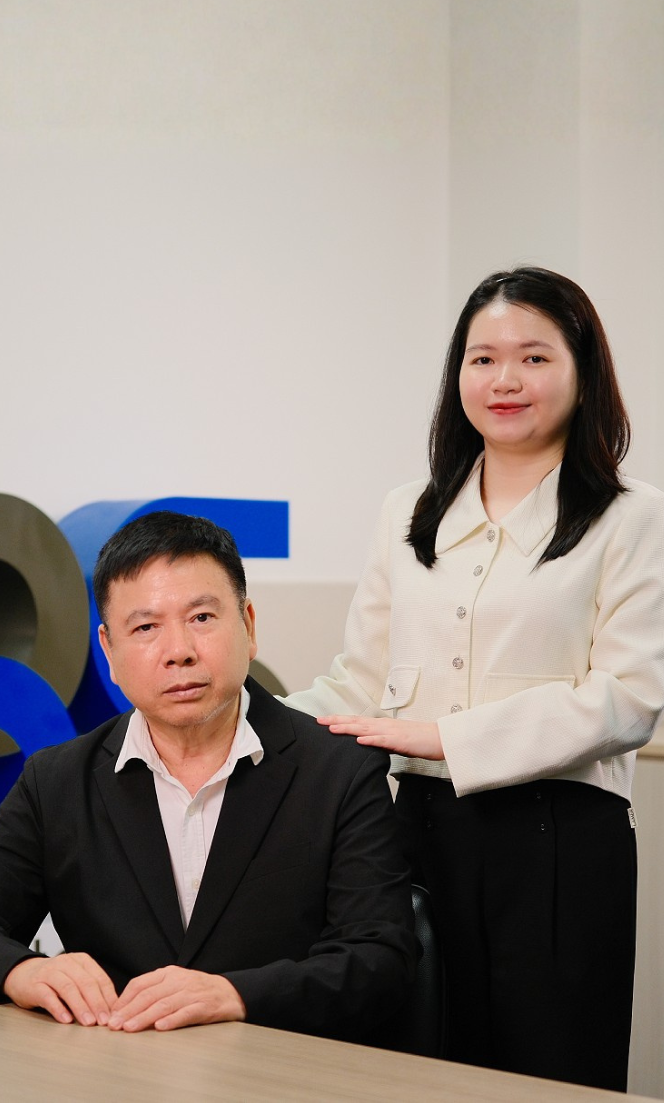
“Như là” is commonly used in Vietnamese when giving examples, sharing real-life stories, or simply connecting different ideas. Perhaps that is why I have always been curious about other people’s stories. I find myself drawn to those who share a similar role to mine a successor, a young person, and a lifelong learner trying to find my own path. Since 2023, I have had the opportunity to work in my father’s business, 3S Software, an IT company serving manufacturing and distribution businesses in Vietnam. With around 20 employees, most of whom specialize in ERP implementation, the company has given me the opportunity to wear many hats from Marketing and Sales Support to HR, Partnerships, and Assistant to the CEO. Rather than following a clearly defined position, I have often found myself filling whatever gaps the business needed me to fill.
One experience particularly changed the way I looked at my role in the family business. Before Tet, I received mixed feedback from a prospect, a partner, and our internal team regarding a sales presentation. Everything seemed to be going in different directions, and I felt overwhelmed because the outcome was far from what I had expected. I remember calling my RMIT Entrepreneurship professor, Mr. Eytan Shaham, to ask for advice. He listened to everything I shared, encouraged me to step back and look at the facts, and then asked me simple but powerful questions: Were we aligned with the prospect’s expectations? What was unusual about this situation? What could I improve?
And perhaps most importantly, how could I make my next project become “Như Ý”? That conversation taught me that being a successor is not about making everything go according to plan. It is about learning how to understand different perspectives, identify what is really happening, and continuously improve the way I contribute to the business.
Through the RMIT Family Business Club and related events, I have had the privilege of listening to many different succession stories. I have seen different pathways, business models, industries, visions, and expectations that one generation hopes to pass on to the next. One successor chose to build a career outside the family business first, hoping to prove his capabilities to both the board and his parents. Another daughter had been working in her family business since she was eighteen. Someone else built an agency under the family company, while another started a new venture from scratch with people from the older generation. Some joined their family businesses when the companies were at their peak; others stepped in during times of crisis. These stories have made me realize that there is no single definition of a “right” successor, and perhaps there is no single pathway to succession either. Each family business has its own story, its own challenges, and its own version of “Như Ý.” For me, the journey is not simply about inheriting a business. It is about discovering what I can contribute, understanding what my generation can bring to the table, and learning how to connect the values of the past with the possibilities of the future.
“Như là” is commonly used in Vietnamese when giving examples, sharing real-life stories, or simply connecting different ideas. Perhaps that is why I have always been curious about other people’s stories. I find myself drawn to those who share a similar role to mine a successor, a young person, and a lifelong learner trying to find my own path. Since 2023, I have had the opportunity to work in my father’s business, 3S Software, an IT company serving manufacturing and distribution businesses in Vietnam. With around 20 employees, most of whom specialize in ERP implementation, the company has given me the opportunity to wear many hats from Marketing and Sales Support to HR, Partnerships, and Assistant to the CEO. Rather than following a clearly defined position, I have often found myself filling whatever gaps the business needed me to fill.
One experience particularly changed the way I looked at my role in the family business. Before Tet, I received mixed feedback from a prospect, a partner, and our internal team regarding a sales presentation. Everything seemed to be going in different directions, and I felt overwhelmed because the outcome was far from what I had expected. I remember calling my RMIT Entrepreneurship professor, Mr. Eytan Shaham, to ask for advice. He listened to everything I shared, encouraged me to step back and look at the facts, and then asked me simple but powerful questions: Were we aligned with the prospect’s expectations? What was unusual about this situation? What could I improve?
And perhaps most importantly, how could I make my next project become “Như Ý”? That conversation taught me that being a successor is not about making everything go according to plan. It is about learning how to understand different perspectives, identify what is really happening, and continuously improve the way I contribute to the business.
Through the RMIT Family Business Club and related events, I have had the privilege of listening to many different succession stories. I have seen different pathways, business models, industries, visions, and expectations that one generation hopes to pass on to the next. One successor chose to build a career outside the family business first, hoping to prove his capabilities to both the board and his parents. Another daughter had been working in her family business since she was eighteen. Someone else built an agency under the family company, while another started a new venture from scratch with people from the older generation. Some joined their family businesses when the companies were at their peak; others stepped in during times of crisis. These stories have made me realize that there is no single definition of a “right” successor, and perhaps there is no single pathway to succession either. Each family business has its own story, its own challenges, and its own version of “Như Ý.” For me, the journey is not simply about inheriting a business. It is about discovering what I can contribute, understanding what my generation can bring to the table, and learning how to connect the values of the past with the possibilities of the future.
